"Oudooey"
I nodded. It was a band I had never heard of. I turned to the next person.
"Si. Anch'io. oudooey."
I was perplexed. The young man saw my expression.
"The big, grande, group from Irlanda. Con Bono."
I shook my head. It wasn't ringing any bells.
"Irrem," was the next answer.
I repeated, "Irrem?"
"Si, from America."
"An American group?"
"Si, famosissime, verrry famous."
My gaze turned onto the last student in the class.
"The Queen," he said.
I looked at him , "the queen doesn't sing."
"Ma si, The Queen. Freddie Merrcurrrry."
"Queen."
"si, the Queen."
I had just asked my students what their favourite group was.
I hadn't realised then (about 15 years ago when U2 and REM were huge) just how much was translated. Even the French, strong proponents of translating everything try to say 'you two,' albeit with a strong French accent for U2.
Over the years, erroneous translations have led to some bizarre conversations.
To wit:
"There were the bitches on the Tiber Island."
I registered the word. "Bitches. As in female dogs? How could you tell?"
Strange look from student, " No, bitches, you know."
" Female dogs."
"No, women," he whispered, a shade red in hue.
"Malicious women? How did you know? How could you tell?"
He shifted in his seat, bright red by now, "they wear the shorts."
"Ahhhh." The penny dropped. Like the women who line the Via Salaria or the Cristoforo Colombo at night.
A too close attention to the translation of 'figlio di puttana' as 'son of a bitch' had led my student to the wrong conclusion that a puttana and a bitch were one and the same.
Or pity the student when faced with a test said "ma questa é la prova?"
My confident "yes," reassured him. I had understood the French meaning 'une épreuve' for 'prova' ( a test) he had meant, a mock test. He handed in an incomplete paper and turned up the following week with a confident, "I'm ready now. I've studied." He had failed already.
And for a while I couldn't understand why so many students were going on holiday to 'Monaco', in my mind, a rather small principality most famous for its casino and Grace Kelly. It turned out they were talking about 'Monaco di Baviera' aka Munich.
That was years ago when my Italian was shakier than it is now.
But every now and again, as I deal with language, a pearl turns up, such as the young student who recently in an essay wrote "hand jobs are rare nowadays."
Go figure what he really meant!
Sunday, 22 January 2017


Sunday, 8 January 2017
Mi garba Garbatella
The tip of my nose is cold. Strange. My dog is nestled against me. The old cat is on the pillow. I glance at the clock and hazard an arm out from under the duvet. It's cold. It's also 8 o'clock and the centralised heating has been on for two hours. To little effect, or so it would seem. My bedside clock indicates 14°C. So for the first time this winter the temperature outside has dipped below zero.
I get dressed quickly. In Scandinavia in the winter they get temperatures of minus 20 but the houses and flats are a balmy 20°C. In Rome at the first whiff of colder weather (it never gets that cold despite what some people might think) and the heating system demonstrates just how useless it is.
Maybe a coat for the dog today? We head out towards Garbatella and the farmers' market where I can get a week's supply of fresh vegetables and some of that delicious Lariano bread, perfect for making bruschette or bread soup, or some fresh, stuffed pasta. The thought of fresh lemon ricotta ravioli or pumpkin almond tortelli buoys me on.
We cross the mighty artery that is the Cristoforo Colombo, every junction has a commemorative plaque or some flowers, testimony to how dangerous the traffic can be. Last year, on this very spot, a cyclist was knocked off his bike by a bus. The cyclist was on the cycle lane but the driver of the bus never saw him. A white bicycle attached to some railings is all that remains to remember a life.
I pass in front of a juggler, even in this chilly weather he is trying to coax a few coins from the jaded motorists waing for the light to turn green. We walk past the great ugly 'Regione Lazio' building - scene of a scandal or two over the years and where from time to time lacklustre demonstrations are staged.
Just past the roundabout, a man warns me to be careful. There are gypsies with a nasty dog that he says could attack my dog. I thank him for the warning. Fortunately, I'm not going in the direction he has indicated.

Piazza delle Sette Chiese, part of the pilgrim trail, is quiet this early. A man is feeding some pigeons who flutter around him. The birds swoop, dive, nip and jab at each other as they come in for a crumb. We walk past him into the old part of Garbatella with its project units known as 'lotto'. On the buildings the original stones still mark which number 'lotto' they belong to.
The area was built in the 1920s, the first stone was laid by King Victor Emmanuel in 1918 on Piazza Benedetto Brin.
 Each lotto is made up of several buildings grouped around a common yard or garden. All the families in the 'lotto' could meet if they so wished in these common shared grounds - they were also known as Case Popolare, the rents were cheap.
 Today, the cachet of the area has changed. From its origins as a rather seedy area associated with lowlifes and criminals ( as the crow flies it is close to the infamous 'Magliana' district) it has become trendy. It is seen as an enviable place to live. Rents have sky-rocketed especially since the closure of the old 'mercati generali'. A popular TV series 'I Cesaroni' depicting the travails of the Cesaroni family, is set here.
The modern area of Garbatella surrounds the large road, Circonvallazione Ostiense, which since a new bridge was built over the metro tracks, links up with the Via Ostiense and thence towards the south of the city. Along this main thoroughfare are all the principal shops and restaurants as well as Garbatella market. Behind the market, towards the train tracks, is a large hangar which houses EATALY a shop and series of restaurants dedicated to promoting Italian food.
On my way to the farmers' market I always pass a curious structure it's a primary school. Four large eagles perched atop indicate its fascist origins. It and the rectangular piazza on which it stands, Piazza Damiano Sauli, were built in the 1930s.

At the end of the road, I go down some battered steps littered with broken beer bottles among the weeds. The round structure in front of me is covered in street art and graffitti, the Roman wolf adorns one wall, a clear reminder, as if I needed one, that Garbatella is indeed the true heartland of the Roma (football) fan.
I go up one of the side ramps into the edifice, a round high ceilinged room which has been partitioned off with large cheerful panels indicating farmer's market. When I discovered this market, at the beginning of 2015, it was seldom busy but it has been found by others.
There are so many people the sound of their talk is echoing off the vaulted ceiling. My favourite vegetable stall is heaving with produce: large dark green savoy cabbages, cauliflowers, chard, artichokes...... The woman who runs it is running about filling brown paper bags, weighing and toting it up. She's busy. At the goat cheese and truffle counter, a few people are trying some samples.
 I get what I need and head out down past the grandly named, it is an imposing structure, Pallladium Theatre. It also dates to the 1930s. The architect was inspired by ancient Roman architecture. Sadly, due to lack of funds the theatre has had to close down. We loop back up the hill towards the 'Regione Lazio' building.
We pass more of the 'lotto' , some of the edifices within are grand, others are smaller. Laundry is draped out of windows on wires to dry in the cold breeze. "Sunday, laundry day", I think. A wall I see has it's top bricks painted in yellow and red, the Roma football team colours of course.
 Piazza delle Sette Chiese is now bustling with life. Mass is over and the congregation has spilled out onto the square. Children are kicking a ball around, dogs are baying at each other, the 'Pizza al Taglio' shop has a few early customers while the 'gelateria' is closed. Most ice-cream shops close in winter for their annual holiday!
I bump into a fellow dog walker who has just been to the dog park next to the shared communal gardens, an area tended by the inhabitants with flowering plants, fruit trees and a vegetable garden. On a previous visit, I had been saddened to notice the reported theft of a tree. The place is open to all. Who would do that?
My shopping bags are weighing me down a little. Time to hurry home. The juggler has moved on from his post at the traffic lights. Too cold? Or maybe he's earned enough for a warm mug of hot chocolate.
I get dressed quickly. In Scandinavia in the winter they get temperatures of minus 20 but the houses and flats are a balmy 20°C. In Rome at the first whiff of colder weather (it never gets that cold despite what some people might think) and the heating system demonstrates just how useless it is.
Maybe a coat for the dog today? We head out towards Garbatella and the farmers' market where I can get a week's supply of fresh vegetables and some of that delicious Lariano bread, perfect for making bruschette or bread soup, or some fresh, stuffed pasta. The thought of fresh lemon ricotta ravioli or pumpkin almond tortelli buoys me on.
We cross the mighty artery that is the Cristoforo Colombo, every junction has a commemorative plaque or some flowers, testimony to how dangerous the traffic can be. Last year, on this very spot, a cyclist was knocked off his bike by a bus. The cyclist was on the cycle lane but the driver of the bus never saw him. A white bicycle attached to some railings is all that remains to remember a life.
I pass in front of a juggler, even in this chilly weather he is trying to coax a few coins from the jaded motorists waing for the light to turn green. We walk past the great ugly 'Regione Lazio' building - scene of a scandal or two over the years and where from time to time lacklustre demonstrations are staged.
Just past the roundabout, a man warns me to be careful. There are gypsies with a nasty dog that he says could attack my dog. I thank him for the warning. Fortunately, I'm not going in the direction he has indicated.

Piazza delle Sette Chiese, part of the pilgrim trail, is quiet this early. A man is feeding some pigeons who flutter around him. The birds swoop, dive, nip and jab at each other as they come in for a crumb. We walk past him into the old part of Garbatella with its project units known as 'lotto'. On the buildings the original stones still mark which number 'lotto' they belong to.
The area was built in the 1920s, the first stone was laid by King Victor Emmanuel in 1918 on Piazza Benedetto Brin.


The modern area of Garbatella surrounds the large road, Circonvallazione Ostiense, which since a new bridge was built over the metro tracks, links up with the Via Ostiense and thence towards the south of the city. Along this main thoroughfare are all the principal shops and restaurants as well as Garbatella market. Behind the market, towards the train tracks, is a large hangar which houses EATALY a shop and series of restaurants dedicated to promoting Italian food.
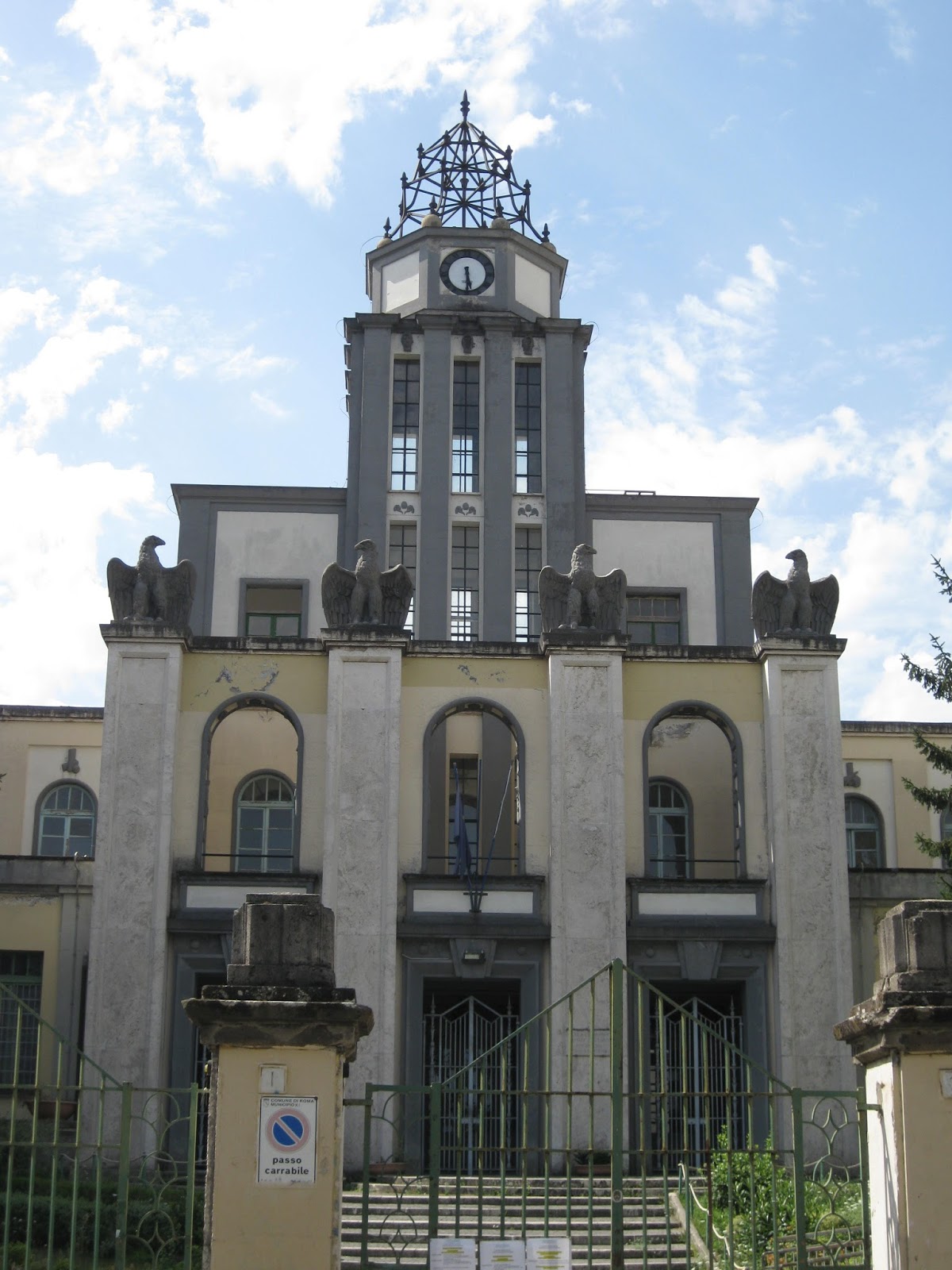
On my way to the farmers' market I always pass a curious structure it's a primary school. Four large eagles perched atop indicate its fascist origins. It and the rectangular piazza on which it stands, Piazza Damiano Sauli, were built in the 1930s.
At the end of the road, I go down some battered steps littered with broken beer bottles among the weeds. The round structure in front of me is covered in street art and graffitti, the Roman wolf adorns one wall, a clear reminder, as if I needed one, that Garbatella is indeed the true heartland of the Roma (football) fan.

I go up one of the side ramps into the edifice, a round high ceilinged room which has been partitioned off with large cheerful panels indicating farmer's market. When I discovered this market, at the beginning of 2015, it was seldom busy but it has been found by others.
There are so many people the sound of their talk is echoing off the vaulted ceiling. My favourite vegetable stall is heaving with produce: large dark green savoy cabbages, cauliflowers, chard, artichokes...... The woman who runs it is running about filling brown paper bags, weighing and toting it up. She's busy. At the goat cheese and truffle counter, a few people are trying some samples.
 I get what I need and head out down past the grandly named, it is an imposing structure, Pallladium Theatre. It also dates to the 1930s. The architect was inspired by ancient Roman architecture. Sadly, due to lack of funds the theatre has had to close down. We loop back up the hill towards the 'Regione Lazio' building.
 We pass more of the 'lotto' , some of the edifices within are grand, others are smaller. Laundry is draped out of windows on wires to dry in the cold breeze. "Sunday, laundry day", I think. A wall I see has it's top bricks painted in yellow and red, the Roma football team colours of course.
 Piazza delle Sette Chiese is now bustling with life. Mass is over and the congregation has spilled out onto the square. Children are kicking a ball around, dogs are baying at each other, the 'Pizza al Taglio' shop has a few early customers while the 'gelateria' is closed. Most ice-cream shops close in winter for their annual holiday!
I bump into a fellow dog walker who has just been to the dog park next to the shared communal gardens, an area tended by the inhabitants with flowering plants, fruit trees and a vegetable garden. On a previous visit, I had been saddened to notice the reported theft of a tree. The place is open to all. Who would do that?
My shopping bags are weighing me down a little. Time to hurry home. The juggler has moved on from his post at the traffic lights. Too cold? Or maybe he's earned enough for a warm mug of hot chocolate.
Friday, 30 December 2016
Lentils
"Lentils?!" I exclaimed, a touch puzzled. I associated lentils with cheap student meals: little lumps of brown in a bland broth.
"My mother's lentil soup is delicious," said my friend. I was skeptical.
"But why lentils?"
"Lentils symbolise prosperity. The more you eat the richer you'll be in the new year."

Lentils and a sausage (cotechino) or stuffed pig's trotter (stinco di maiale) was the traditional dish for New Year's Eve.
So what could I do but try it? I boiled the lentils and the sausage as indicated on various packet instructions. It all looked, well, rather uninviting. It was. The lentils were soggy and had a distinct earthiness to them. The sausage had an unappealing puddle of fat leaking from it. I ate a few mouthfuls and gave up. Nobody could be that desperate for wealth.
I asked around a bit more. It seemed I had used the wrong type of lentils. Now those grown on the plains around Norcia and Castelluccio were the ones to use. The cotechino could be enhanced with a little mostarda, which isn't mustard, but candied fruit in a spicy syrup. It looked like just not-the-thing to have with meat.
But I gave it another try. The lentils were definitely tasty but the cotechino? Let's say greasy sausage and sweet spicy syrup are not a marriage made in heaven - though a lot of Italians would swear otherwise.
It turns out the whole traditional New Year's Eve menu is geared towards prosperity in the new year. The lentils because they are round, flat and vaguely golden in hue represent coins. The fatty meat symbolizes abundance. The meal is then rounded off with grapes to ensure frugality with the new found wealth.
However, as I peruse my food magazines, looking for a new take on old lentils, I realise that I may not be the only person who finds the New's Year Eve menu a tad dull. My eye is caught by the picture of little nests of filo pastry with dainty spoonfuls of lentils in them and cubes of cotecchino atop. It looks nice - maybe without the sausage? But would such a small quantity of lentils bring me the desired prosperity?
"My mother's lentil soup is delicious," said my friend. I was skeptical.
"But why lentils?"
"Lentils symbolise prosperity. The more you eat the richer you'll be in the new year."

Lentils and a sausage (cotechino) or stuffed pig's trotter (stinco di maiale) was the traditional dish for New Year's Eve.
So what could I do but try it? I boiled the lentils and the sausage as indicated on various packet instructions. It all looked, well, rather uninviting. It was. The lentils were soggy and had a distinct earthiness to them. The sausage had an unappealing puddle of fat leaking from it. I ate a few mouthfuls and gave up. Nobody could be that desperate for wealth.
I asked around a bit more. It seemed I had used the wrong type of lentils. Now those grown on the plains around Norcia and Castelluccio were the ones to use. The cotechino could be enhanced with a little mostarda, which isn't mustard, but candied fruit in a spicy syrup. It looked like just not-the-thing to have with meat.
 |
| Traditional: cotechino, lentils and mostarda |
But I gave it another try. The lentils were definitely tasty but the cotechino? Let's say greasy sausage and sweet spicy syrup are not a marriage made in heaven - though a lot of Italians would swear otherwise.
It turns out the whole traditional New Year's Eve menu is geared towards prosperity in the new year. The lentils because they are round, flat and vaguely golden in hue represent coins. The fatty meat symbolizes abundance. The meal is then rounded off with grapes to ensure frugality with the new found wealth.
 |
| lentil lasagna |
However, as I peruse my food magazines, looking for a new take on old lentils, I realise that I may not be the only person who finds the New's Year Eve menu a tad dull. My eye is caught by the picture of little nests of filo pastry with dainty spoonfuls of lentils in them and cubes of cotecchino atop. It looks nice - maybe without the sausage? But would such a small quantity of lentils bring me the desired prosperity?
Tuesday, 27 December 2016
First words: ragazzi, ragazze
Turn back the clock, eighteen years: it’s
summer. It’s hot. I pace in front of the blackboard. I hate the thing, after
three hours I’m covered in chalk dust. Back and forth I go and wonder where my
students are. They file in, in their
camouflage gear , greens and khakis. Twenty conscripts entering the quonset hut
for their obligatory English lesson. They don’t want to be here. Do I?
There is only one window, at the back of
the room and the sun is beaming through it. I can make out a bobbing sea of
heads but nothing else with the light shining in my eyes. I beam, the
not-quite-yet-perfected stage smile: “Ciao
ragazzi!”. One of the few phrases I know in Italian. The more enthusiastic
among them answer, “’ello teacheerrr.”
Roll on to 2016, it’s lunchtime and I’m
sitting in reception. Head office calls:
“Are any of the ragazze there?” asks
Clara in her cherpy voice, just too high pitched to be genuine. I pause. Ragazze (girls)? I know who she means so
I say: “No, they’re at lunch.”
September, the month when we do the level
testing. I’m whiling away the time in the staff room when one of the
secretaries calls me “there’s a ragazza in reception waiting to do her
test.” Mentally I imagine a child then
dismiss that as children are called ‘bambini’.
So, I think, a young teen, maybe a university student? I round the corner and
face a woman whose girl-hood is long past.
Have I reached the land of eternal youth?
The
term ‘ragazzi’ can simply mean
‘guys’ as in ‘hey, guys’ which was the
use I made of it back in the days when I was going from army base to army base,
entertaining (i.e. teaching)the
conscripts. The Italian military didn’t know what to do with them so English
lessons. The following year obligatory conscription was done away with.
The term ‘ragazzi’ or ‘ragazze’ (singular:
ragazzo or ragazza) seems
applicable to everyone provided the interlocutor is older, or considers
themselves in some way ‘superior’. This last is in itself a hard concept to
assess as it is often a figment of the speaker’s imagination.
University professors may call exams, forget
to cancel and not turn up. The next session for that exam will be in six
months’ time. Never mind, the ragazzi (university sudents) who have
studied for it, stressed over it, will understand. Company bosses may forget to
cancel meetings, never mind the ragazzi,
their employees, won’t (can’t) complain.
Many people consider it a friendly gesture,
there’s nothing wrong with calling a group of adults ‘ girls’ and ‘boys’
whatever their age. But it is also a
not-so-subtle belittling. The language makes sure people are kept in their
places.
Italy
is an ageist country. Magazine articles have the ages of the people in
brackets beside their names. Much debate goes on about the relative
youth or not, of public figures, with the attendant comments on their
appearance, even more markedly so if a woman (ragazza) is being talked about.
At job interviews age is mentioned alongside other topics which in many countries are considered inappropriate.
Then at a certain point in a
persons life the notion that age confers automatic respect comes into
play. Thus, the indignant, “how dare
you say that to me. How dare you speak to a person of my age in such a
way.”
Never mind the speaker may only be a few years older. Never mind that
the person has done nothing to deserve respect.
I’m looking forward to playing that card!
Sunday, 11 December 2016
Strolling down the high street
There are people everywhere: laughing, chatting, toting shopping bags with the names of international high-street brands emblazoned on them. and gesticulating as they hold shouting volume conversations on their Smart phones. Toy dogs in plaid coats tug at their leashes. A bicycle whizzes past. A woman shrieks as a rat darts alongside the pavement past her Louboutins. Parents push strollers round the pot-holes and narrowly miss the ankles of love struck teens walking arm in arm. A group of loud American tourists push their way through the throng on their hired rickshaw. A police car slowly wends its way forwards, pauses, then continues. This is Via del Corso, Rome's high street.

Its present name dates from the 15th century when, for the carnival, riderless horses would race down its length in a 'corsa dei barbari'. It was well suited for this being the only perfectly straight road in an area characterised by meandering tight alleys and small piazzas.
Before that (from circa 220AD) it was known as the 'Via Lata' (broad way) - and spanning 10 metres wide for the ancients this was indeed a wide road. It was part of a much longer road that stretched as far as the Adriatic. What remains today is 1.5kms long, from Piazza Venezia to Piazza del Popolo, and straight as a die. What was considered with awe in ancient times is considered with irritation in current times.
It takes little to block it. The road is part of the designated ZTL (zona traffico limitato) but not included in the limited traffic are the daily buses, taxis and parliamentary vehicles that run up and down it in continuation.
I start my walk as I alight from the bus opposite the imposing facade of the Palazzo Doria- Pamphilj. Ten years ago, I worked for a school which had its headquarters on the fifth floor of the building. I'd enter through an imposing door and start my long slow climb up. There was a lift. Its coffin-like dimensions and slowness made me imagine a bent old man somewhere in the cellars of the building cranking a rusty handle round and round a pulley which lifted the box up into the heights of the palazzo.
 I always went up the stairs, two narrow flights past the entrance to a private university. Then out of nowhere a large, rather grand looking marble stairway appeared but the worn, shallow steps were slippery. I would pause at the top of them beside the entrance to a legal office and peer down into a splendid courtyard. The last leg involved a very narrow flight of fifteen steps past a private apartment where an elderly man would walk on the narrow landing with his zimmer frame up and down, up and down. Finally. a bit out of breathe I would climb the last steps to the locked glass door of the school where almost every time someone would ask, "but why didn't you use the lift?"
 Today I notice that the courtyard is open so I go in and have a look at the orange and lemon trees and the famed renaissance colonnade before resuming my walk up the street past the church of Santa Maria in Via Lata which in the fifteenth century operated a soup kitchen for the needy and onwards past the church of San Marcello on its small piazza.
Down side alleys tables are set up, some are still occupied by a few late diners though this being the heart of touristic Rome most of the restaurants offer non-stop service from lunch through to dinner with low quality over-priced fare.
 I came out early so as to avoid the passegiata - starting around 4pm when Italians come out to stretch their legs after lunch and walk off some of the pasta. The Corso is not well-designed for crowds of people. The pavements are narrow and the herds of bovine-like tourists clog it up. They move forward in clusters clad in their identical red T-shirts or sporting a baseball cap or following a yellow flag held aloft by their guide.
Locals push around them or through them as they try to get on with their daily business: civil servants going from building to building, shop assistants on a break, waiters bearing aloft trays of food and swearing beneath their breathe in the best romanaccio as yet another careless tourist cuts in front of them...
If the street has a middle point it would be around the height of Piazza Colonna with the victory column of Marcus Aurelius standing proud with its depictions in relief of the Danubian or Marcomannic wars. Closer to the road is a fountain. Gulls often perch on it.
 Opposite the Piazza is the restored art nouveau Galleria Colonna. It was renamed Galleria Alberto Sordi after a famous Roman actor who died in 2003 the year the gallery was re-opened in its present incarnation as a shopping mall.
After a brief foray into the gallery, to a large book shop, I continue up the Corso towards Piazza del Popolo. I pass by Palazzo Chigi home of the Prime Minister.
It was bought by the Chigi family, from the Aldobrandini who had run out of money and left it unfinished. The Chigi finished the job. Pope Alexander VII (a Chigi) was responsible for tidying up Piazza Colonna and much of the Corso which up until then had been semi-permanent building site.
 Since the 15th century
the Corso had been a fashionable place for new building projects funded by either the
church or the nobility. Churches sprung up mushroom like and nobles
erected palaces. Then as now, resources would run out and a once
sprightly building site would be reduced to disuse and abandonment.
Since the 15th century
the Corso had been a fashionable place for new building projects funded by either the
church or the nobility. Churches sprung up mushroom like and nobles
erected palaces. Then as now, resources would run out and a once
sprightly building site would be reduced to disuse and abandonment.
As I walk down the road past the entrance to the upmarket Via Condotti with a distant glimpse of the Spanish Steps, past the impressive Fendi building adjacent to a vast H&M retailer, I notice the many signs affixed to facades telling people of illustrious guests, or the names of the palazzi, or old faint letters which describe a past occupation for the building. The history of the road is there for all to read.
 The old Metropolitan cinema, where I used to see films in original version, is still there, all boarded up. Numerous shops have come and gone.
The church of Santa Maria dei Miracoli is hidden under scaffolding but its 'twin' Santa Maria in MonteSanto has come out of wraps looking cleaner. They are both 17th century baroque churches.
I stand at the end of the street and look northwards just making out through the crowd which is growing by the minute, the white Victor Emmanuel monument, 1,5 kilometres away.


Its present name dates from the 15th century when, for the carnival, riderless horses would race down its length in a 'corsa dei barbari'. It was well suited for this being the only perfectly straight road in an area characterised by meandering tight alleys and small piazzas.
Before that (from circa 220AD) it was known as the 'Via Lata' (broad way) - and spanning 10 metres wide for the ancients this was indeed a wide road. It was part of a much longer road that stretched as far as the Adriatic. What remains today is 1.5kms long, from Piazza Venezia to Piazza del Popolo, and straight as a die. What was considered with awe in ancient times is considered with irritation in current times.
It takes little to block it. The road is part of the designated ZTL (zona traffico limitato) but not included in the limited traffic are the daily buses, taxis and parliamentary vehicles that run up and down it in continuation.
I start my walk as I alight from the bus opposite the imposing facade of the Palazzo Doria- Pamphilj. Ten years ago, I worked for a school which had its headquarters on the fifth floor of the building. I'd enter through an imposing door and start my long slow climb up. There was a lift. Its coffin-like dimensions and slowness made me imagine a bent old man somewhere in the cellars of the building cranking a rusty handle round and round a pulley which lifted the box up into the heights of the palazzo.
 I always went up the stairs, two narrow flights past the entrance to a private university. Then out of nowhere a large, rather grand looking marble stairway appeared but the worn, shallow steps were slippery. I would pause at the top of them beside the entrance to a legal office and peer down into a splendid courtyard. The last leg involved a very narrow flight of fifteen steps past a private apartment where an elderly man would walk on the narrow landing with his zimmer frame up and down, up and down. Finally. a bit out of breathe I would climb the last steps to the locked glass door of the school where almost every time someone would ask, "but why didn't you use the lift?"
Down side alleys tables are set up, some are still occupied by a few late diners though this being the heart of touristic Rome most of the restaurants offer non-stop service from lunch through to dinner with low quality over-priced fare.

Locals push around them or through them as they try to get on with their daily business: civil servants going from building to building, shop assistants on a break, waiters bearing aloft trays of food and swearing beneath their breathe in the best romanaccio as yet another careless tourist cuts in front of them...
If the street has a middle point it would be around the height of Piazza Colonna with the victory column of Marcus Aurelius standing proud with its depictions in relief of the Danubian or Marcomannic wars. Closer to the road is a fountain. Gulls often perch on it.
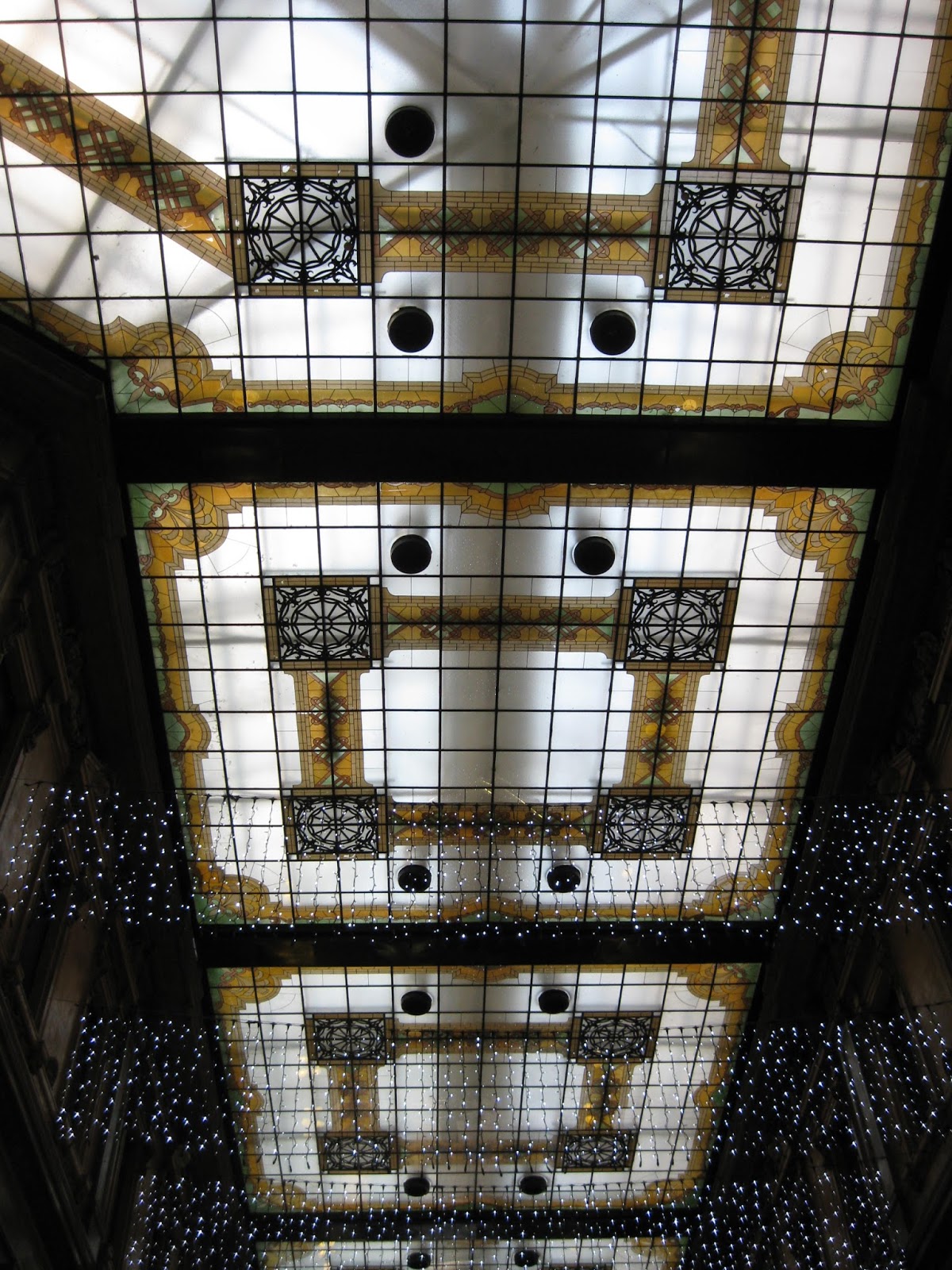
After a brief foray into the gallery, to a large book shop, I continue up the Corso towards Piazza del Popolo. I pass by Palazzo Chigi home of the Prime Minister.
It was bought by the Chigi family, from the Aldobrandini who had run out of money and left it unfinished. The Chigi finished the job. Pope Alexander VII (a Chigi) was responsible for tidying up Piazza Colonna and much of the Corso which up until then had been semi-permanent building site.

As I walk down the road past the entrance to the upmarket Via Condotti with a distant glimpse of the Spanish Steps, past the impressive Fendi building adjacent to a vast H&M retailer, I notice the many signs affixed to facades telling people of illustrious guests, or the names of the palazzi, or old faint letters which describe a past occupation for the building. The history of the road is there for all to read.

The church of Santa Maria dei Miracoli is hidden under scaffolding but its 'twin' Santa Maria in MonteSanto has come out of wraps looking cleaner. They are both 17th century baroque churches.
I stand at the end of the street and look northwards just making out through the crowd which is growing by the minute, the white Victor Emmanuel monument, 1,5 kilometres away.

Subscribe to:
Posts (Atom)