Monday, 17 April 2017

Little Easter

Pasquetta (literally little Easter) or Easter Monday is a day to be spent in company and traditionally outdoors with a picnic lunch. This, in a nation who in the summer will send their offspring to the beach with pasta for lunch, is no small under-taking.

It also involves no small amount of rubbish which the day after Pasquetta the gulls, crows and pigeons take great delight in strewing even further afield than the humans have left them. 

A walk in the park when I lived in Monteverde, in Villa Pamphili, the day after Pasquetta, was an olfactory and gustatory delight for my dog but a nightmare of flying food wrappers and pizza crusts left in situ.The very large bin containers that had been dragged into the park on city council orders to accomodate the extra rubbish, had been ignored. 

Last year was a DVDs only type of Easter Monday, relentless rain and people commenting: "just like where you're from." But this year it's bright and sunny which means getting out soon to avoid the crowds.

I head to the Caffarella, a large park off the Appia Antica. We pass the church of Quo Vadis (not named after the film!) but so-called because this is where Saint Peter met Jesus while Peter was fleeing persecution in Rome. According to legend, Peter asked Jesus: Lord, where are you going? (Domine quo vadis?) And Jesus replied, "I'm going to Rome to be crucified again." Ella decides this is as good a place as any other to have a dump. She would. She's a dog. 

I pick up after her and realise there isn't anywhere to dispose of the offending parcel. None of the unattractive bruised dumpsters that adorn the roads of Rome are visible.I walk down Via della Caffarella and notice that I am not the first person to have faced the problem. Bright pink, red or orange plastic poo bags have been abandoned on walls, at the foot of trees, in gutters. I sigh. I place the bag in my pocket and hope to come across a bin. In the meantime I shall have to brave on with the whiff of 'Ella number 2' about my person.

I enter the park and get over taken by joggers and cyclists. Romans ride their bikes as they drive their cars so as a pedestrian one needs extra ears and quick reflexes as they will weave semi-expertly in and out and round about. 

I pass an animal farm solely set up for the purpose of letting city kids see farm animals behind the safety of a high fence. Next to me a mother is pointing out a pig to her daughter: "Look, there's Papa Pig, like in the cartoon." And what works for city kids, works for city dogs. Ella is glued to the fence. She gets to see her first chicken, duck, goose and pig. She can't get enough of it. I have to drag her away.


I pass the entrance to the cenotaph of Annia Regilla, a noble Roman woman who was murdered in Greece  in 160AD. The archaeological site is open so I go in.

Two elderly women are seated at one of the picnic trees beneath a pollen shedding tree. I overhear one on the phone: "Yes. I've brought some salami and some cheese. What are you bringing?" I can only imagine that they are waiting for family to start the Pasquetta picnic. I divest myself of 'Ella number 2.'

 There are many streams in the park. And many notices warning people not to bathe in or drink the water.

 
However some dogs are having a merry romp. I arrive at the Ninfeo Egeria - all mossy waters and a suggestive alcove with the remains of a statue. But it is the flock of sheep in the neighbouring field that catch my attention. 

We climb up the hill, past the sacred wood and look down onto the Colombarium of Constantine, not a dovecot but a building which had once been used to keep the ahes of the deceased. 

Further up the hill I pass an ancient Roman cistern amid a field of small yellow flowers. More people are arriving, table cloths are being laid down, large hampers and baskets opened. It's getting hot and Ella is tired. 


Sunday, 9 April 2017

Notes on Rione Monti

I get off the bus outside the grandiose Basilica of Santa Maria Maggiore. A sign of the times is the army vehicle and heavily armed soldiers in camouflage (why? They're in the city.) beside the metal detector that guards the entrance to the basilica. It's Palm Sunday, an important date in the Christian calendar and the faithful are there, queueing up to enter the basilica. 

 I head across Via Cavour and onto Via Urbana which leads down into the heart of the ancient suburra. Back in Roman times the insulae would have dangled precariously over the alley. The stink of the masses would have been overpowering. The area had once been infamous for drugs, violence and prostitution.

Today it is the trendy heart of the city, a village in itself, devoted to boho chic with vintage and second hand clothes shops alongside genuine and less genuine trattorie and other eateries catering to the tourists. 


I pass the church of Santa Pudenziana - home of worship to Rome's extensive Phillipine community and the oldest place of Christian worship in Rome. It dates back to the 4th century.

 As it's Palm Sunday the church is busy. I head off the narrow road up a graffitti-lined staircase onto an attractive plant-filled alley which disappointingly leads onto a large road, one of Monti's principle thoroughfares, Via Panisperna.


Monti is Rome's first district -  central Rome is divided into 22 administrative districts known as 'rioni'. Most of Rome's rioni are included within the old city walls. Over the ages the borders of the rioni have fluctuated.

Monti (Hills) was so called because wthin its original borders it encompassed the Viminale, Esquiline, parts of the Quirinale and Caelian Hills. It extended as far as the Aurelian walls.
Today its 1,6 square kilometres no longer include the Quirinale and Caelian Hills.


At the end of Via Panisperna I turn onto Via dei Serpenti so-called it would seem because of a mosaic depicting the Madonna (?) with her foot on a snake. It is a road I know well. It is home to two excellent Indian restaurants: The Maharaja (a little pricey) and Mother India

I check out the Tuscan emporium (Podere Vecciano) I've heard so much about:all oils, jams and honeys with some pretty hand-painted ceramics. 

I then discover that my invisibility cloak is still working. It works particularly well in domestic appliance/computer supply shops.  Despite the fact that I'm the only customer in the shop the man behind the till (owner?) acts as if I'm not there. In his defence, I could say I was rather shabbily dressed: jeans, T-shirt and cardigan, so fairly obviously not the type of person who'd be going for over-price olive oil and vinegar.


I leave the shop, half regretting not having bought the attractive hand-painted bowl with owls and leaves on it.

At Piazza della Madonna dei Monti a procession is underway. Mass has just finished and a gaggle of nuns followed by the faithful are singing their way down the street for, as it turns out, a short distance, as they turn into the church of the Madonna dei Monti, the one with the snake squashing Madonna, on the street of the same name. 

I walk down the Via della Madonna dei Monti, all very picturesque and weave my way to the back of Augustus' forum. Monti is one of the larger districts and my feet are beginning to feel it.

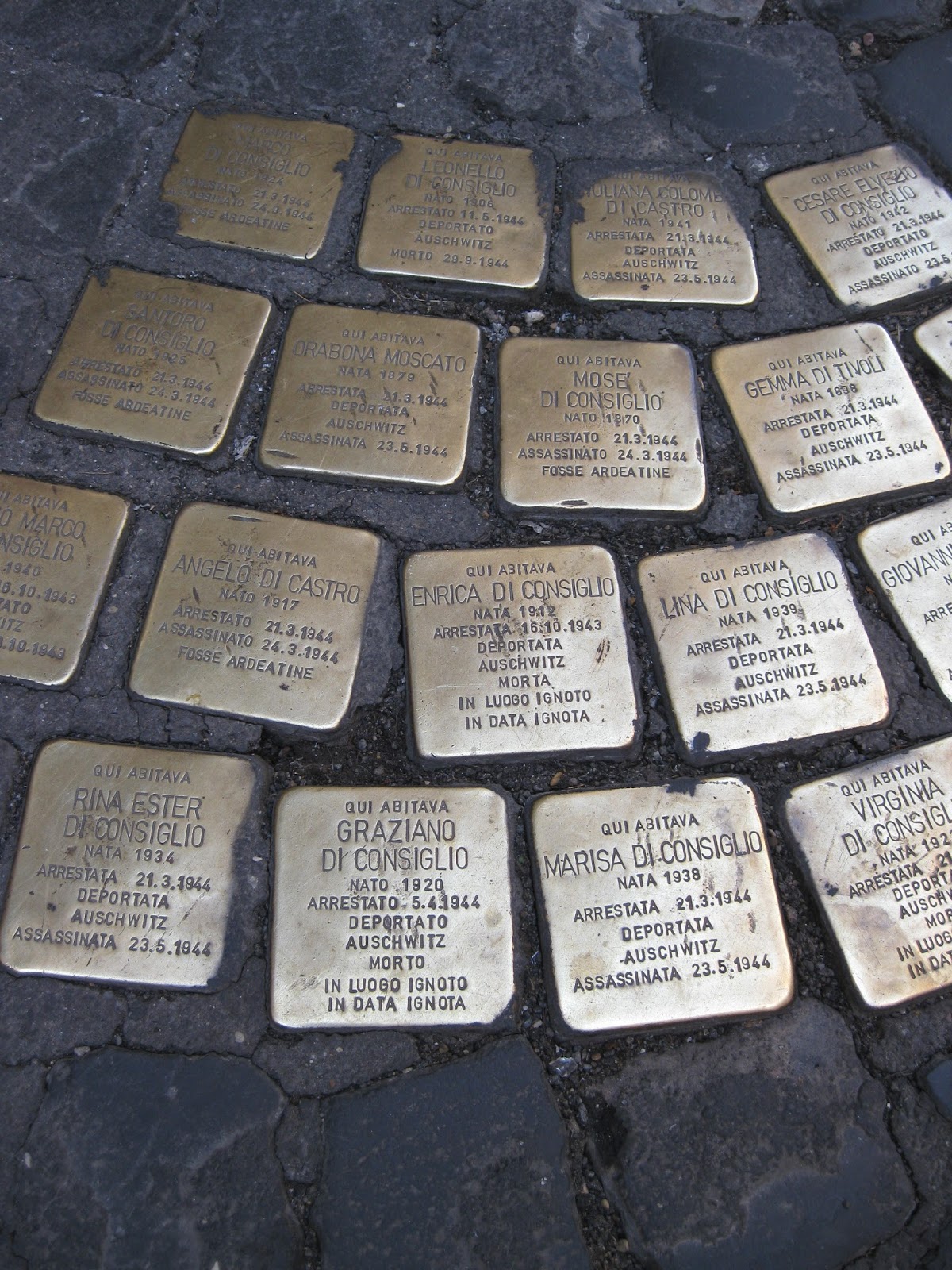
Walking back up Via della Madonna dei Monti I come across a heart rending sight. Embedded in the cobbled road surface are some metal plaques, I bend down closer to read the inscriptions and realise that they are memorials to the people who once lived in the building I am now standing in front of. They lived there and in 1944 were deported to Auschwitz. They never came back. 


 Climbing up and down hills over cobbles and across large roads such as Via Cavour I end up on Via del Colosseo with the Colosseum a great big mass in my sights. I read this week that since 2015 a colony of hedgehogs have made their home there. 

I go past San Pietro in Vincoli, but the Palm Sunday crowd stops me from going in to see Michelangelo's Moses. I walk down the Scalinata dei Borgia (the Borgia steps) across Via Cavour and past Finnegan's Pub. There are many pubs in Rome where ex-pats gather to watch football and rugby matches on flat screen TVs while drinking their pints. 

 Last time I came here at Halloween the pub had been decorated for a party for the owners' children. There had been cotton cobwebs, plastic spiders, skulls, bats and ghosts dangling form every picture frame and mirror and the TVs had been switched off.

I arrive outside the metro stop of Cavour on Piazza della Suburra where an ancient plaque marks the spot.  'tis time to head home. My feet are killing me!


Friday, 24 March 2017

Spring on a plate

It may be true to say that I love artichokes. Growing up I didn't have them that often, but it was a rare treat when I did. Sometime in the late Spring large artichokes would turn up on sale in a few select shops. Occasionally, they would already have been prepared for consumption: decorated with a thin slice of lemon and a few sprigs of curly parsley.

We would sit down for dinner in front of the beautiful artichokes and peel off leaf after shiny leaf. They would be dipped into a sharp vinaigrette and we would bite off that half moon of edible flesh at the base of each leaf before discarding it into a bowl placed in the centre of the table. As the meal progressed the mountain of leaves took shape.

Of course, we were all intent on reaching the soft heart of the artichoke - a reward for all the work it had taken to get there. We would remove the inedible choke and carefully slice the heart and dip it into the vinaigrette relishing each delectable morsel.

So when I got to Rome and saw the artichokes on the market and in the grocery shops I was in for a disappointment. They were smaller and punnier looking than in my memory. The largest, the mammole, fat round globes looked half the size of my childhood artichokes. As for the violet, with their thin oval shape and their sharp spines, they looked too dangerous to touch.

The carciofini, mini artichokes, were a joke. What was there to even eat on them? Whatever could they be used for?


In Rome there are three dishes which feature the artichoke as the star: the 'carciofi alla giudia', the 'carciofi alla romana' and the 'vignarola alla Romana'.

The first involves bashing and deep frying the artichoke. As a typical Jewish dish it can be found all over the Roman ghetto.

I still remember the first time I tasted 'carciofi alla giudia' at a teachers' meeting in a school on Lungotevere Ripa.

I would teach early evening lessons there with one of the most beautiful views I've ever had in a school. The windows were set high above the roaring road that ran alongside the Tiber. Of an evening, I could look out across the river and glimpse  the Church of Santa Maria in Cosmedin with its distinctive bell tower and its Bocca della Verita (the mouth of truth) still open to all and free in those days. There were also some ancient Roman temples part of the Foro Boario. A little higher up the river if I was by the window I could spy the broken bridge (Ponte Rotto) with gulls perched on it and circling and crying above it. As the sun set pink over the city I couldn't imagine anywhere nicer to be.


Sadly, the school closed a year later. But my memory of the artichokes remained.

A mountain of artichokes at my local market
The battered globe with leaves invitingly parted, lightly salted and fried to a crisp were a sensory revelation. They needed no accompaniment they were perfect as such.

I discovered 'Carciofi alla Romana' at a trattoria behind the Colosseum. I should have trusted my imstincts and avoided it. No good can come of a trattoria catering almost solely to tourists.

In my defence, the place had been chosen by my dining companion. She had read a review in a popular guide book which lauded among other things its 'carciofi alla Romana'.

So I ordered them. An oil drenched braised artichoke stuffed with herbs arrived. My friend offered a "that doesn't look very nice," type comment, as I bit into the over-cooked bud. An assault of flavours hit my palate. It tasted strange and vaguely medicinal. I smelt something minty. Was this really the famed Carciofi alla Romana?

I drank from my white wine and noticed its taste had changed. I didn't know it then but it was the chemical constituent cynarine which is found in artichokes that was distorting my taste receptors.

When my desert, a soggy tiramisu soaked in a blue liquid arrived, I decided never ever to pay attention to restaurant recommendations from budget travel guide books again.

But even though it had been a far from perfect first try it had aroused my curiosity. The bizarre flavour had come from the combination of spearmint (mentuccia)  not in fact a genuine ingredient for this recipe with olive oil,rather than the more usual mint,parsley and garlic which are used to stuff the braised artichoke. 

I subsequently tried a much better, more genuine preparation containing the right herbs at a ristorante, (the event being a Christmas dinner) La Matriciana on Piazza dei Consuli  down in the concrete jungle of the Tuscolana. Here the artichokes glistened with a film of olive oil but were firm rather than pulpy and held their combined herbs well. It wasn't cloying or greasy.


Artichokes have proven health benefits:
they can cleanse the liver as well as help
lower cholesterol.

It also inspired me to give it a try: I would make my own 'carciofi alla Romana'.

What I hadn't realised was just how difficult artichokes are to clean with their hidden sharp edges and spines nor their tendancy to go brown due to the oxidising effect of the air.  Hence the use of a water bowl filled with lemon quarters or a drop of vinegar into which to pop the newly cleaned and ready for preparation artichokes.

I understood better why so many markets sold ready cleaned artichokes bobbing merrily in large plastic vats of water and lemon. I understood why the normally parsimonious Romans were happy to pay a little more to avoid the tedium of cleaning them.


With a little practise I got there. I've never quite figured out how to stop them from capsizing in the pan, their bell heads spilling their contents in a less than tidy way into the surrounding water.  They never look quite as perfect as the ones sold in reaturants but I'm sure they're as tasty!

No other dish, however, conjures Spring to mind better than the 'Vignarola'. A vegetable stew made up of spring onions, artichokes, broad beans and fresh peas. Some recipes also throw in Roman lettuce to braise and the first seasonal asparagus.The presence of all these ingredients on the market are a sign that the warm Summer days are but a skip and a jump away.


                        A recipe for Spring on a plate

Vignarola alla Romana:

  • Fresh (or frozen) peas 500gr,  podded and cleaned
  • Fresh broad beans 500gr, podded and cleaned
  • 1 head of Roman lettuce, sliced
  • 100gr pancetta, cut into cubes
  • 500gr artichokes (3 artichokes), cleaned and cut into quarters or sixths
  • 250gr Spring onions, thinly sliced
  • Olive oil
  • Vegetable broth (this can be made from the pea, bean pods boiled with the green shoots of the spring onion) or water
  • Pecorino cheese
  • A sprig of mint
  • salt and pepper


Fry together the spring onions and pancetta.Add the prepared artichokes with a little vegetable broth or water. Cover and cook for 10 minutes. Add the peas and beans and some more broth. Cover and cook for a further 10 mins.Then add the sliced lettuce and cook till all the vegetables are ready.Season with salt, pepper, mint and pecorino cheese.


The origins of this dish are unclear. It may have been called Vignarola because the vegetables grew among the vines,;or it was a dish eaten by the peasants who cultivated the vines; or, more simply it was named after the people who sold them on the Roman markets, the vignaroli. Whatever the dishes origins, it was surely a rustic dish, a reminder of the bounty the earth can produce.


Tuesday, 14 March 2017

The Roman Ghetto

In the district of the Angel lies the old Jewish ghetto. I approached it from the Teatro Marcello side thus passing under the ancient Portico d'Ottavia which gives its name to the main thouroughfare of the ghetto. 

Once it was home to Rome's principal fish market under the portico and beside the church of Sant'Angelo in Pescheria, known as the oratory of the fishmongers (l'oratorio dei pescivendoli).  

Top of the Portico d'Ottavia
The original ghetto lay in the area limited by the contemporary Via del Portico d'Ottavia, Piazza delle Cinque Scole and the Tiber. It was formed on 12 July 1555 by the Pope Paul IV (of the Carafa family) and remained in place for almost 300 years when another Pope, Pio IX (of the Boncompagni family) opened its gates and allowed its people free access to the streets of Rome. For three centuries the enclosed area was unchanged apart for an increase in the number of gates from five to eight and in the number of windows.


Today the portico is enshrined in scaffolding, I skirt around it, into a tunnel and slip behind it into Via della Tribuna Campitelli and walk up towards Piazza Lovatelli, where a man is filling a bottle of water at a street fountain, and onto Via dei Funari. 

There I find myself in front of the Renaissance church of Santa Caterina dei Funari (string and rope makers), renowned for its travertine facade.  As every time I have been past this church it's closed. I have heard that the frescoes and paintings within are well worth seeing. Maybe another day?

Many years ago an eccentric artist used to exhibit his work on the steps that led up to the church: he used mainly acrylic paints, bright colours and canvasses canvassed from the streets. But the only trace I find of him today are some paint stains beside the entrance.


Church of Santa Caterina dei Funari


I continue, past Via dei Caetani where the body of the former Prime Minister and Christian Democrat leader, Aldo Moro, was found in a car. He had been kidnapped, held for 55 days and then murdered and left there by the Red Brigades.

 I arrive at the Piazza Mattei with its equisite 'Fountain of the Turtles' (Fontana delle Tartarughe).

 The Fountain was built by the architect Giacomo della Porta and the sculptor Taddeo Landini. The turtles were added later in 1658 by Gian Lorenzo Bernini or Andrea Sacchi

Like many Renaissance fountains it was designed to bring drinking water to the Roman population. It was, however, one of the few fountains in Rome not built for a pope but for a patron, Muzio Mattei. The fountain, deriving water from the Roman acqueduct of Acqua Vergine would have served the whole neighbourhood. 


Drinking its water today would more likely result in a bad stomach ache if not a visit to the nearest emergency room. A modest sized notice warns people not to drink the water.

I head down Via della Reginella and discover a shop specialised in pepperoncini (chilli peppers). It claims to sell 17 different types of pepperoncini.  

 I pause outside it, toying with the idea of going in. I spy flasks and phials filled with spicy oils and small jars containing powdered versions of the spices. It all looks geared towards the hordes of tourists that pass down here daily. So I head on down past different shops. 

Then, a plaque starkly reminds passers-by of their history. On the 16 October 1943, 1023 Roman jews were rounded up and deported to concentration camps. Very few returned. On 24 March 1944, 75 Jews taken from the ghetto were murdered at the Fosse Ardeatina on the (then) outskirts of Rome. 

I come out of the narrow alley onto the Portico d'Ottavia again. The restaurants are getting ready for lunch.

 Artichokes are everywhere. This is the home of Kosher cuisine and the famed carciofi alla giudea, bashed and deep fried Romanesco artichokes - an absolute must for any visitor to the ghetto. 

Equally prized are the 'baccala' (salted cod) dishes, traditionally served with chickpeas but also fried or in soups...

I walk past the famed 'Forno'  (baker's) but despite knowing that this is where I can get the best visciole (sour cherry) and ricotta pie in Rome I am not tempted. The pies in the window look burnt on top.

Maybe I'm mistaken. Later, as I pass by again I see a long queue snaking out of the shop onto the street. 

It's still a little early for lunch so I head towards Piazza delle Cinque Scole and its fountain with gorgons' heads on it. 


detail on Via del P. d'Ottavia
detail on Via del portico d'Ottavia.
From thence I go in search of Palazzo Cenci, once home of Beatrice Cenci. It's a frustrating search. I go up Monte dei Cenci past a small abandoned chuch then down onto Piazza dei Cenci and past Palazzetto Cenci followed by an Arco dei Cenci with its own bloody tale One thing is clear however, the Cenci were once here.

 
 It would seem that the unfortunate Beatrice Cenci would have lived in a building which backed onto the Monte dei Cenci. She was beheaded along with her mother on Ponte St Angelo for the murder of her father, Francesco Cenci, a violent, incestuous man. Her brother Giacomo was hung, drawn and quartered. The sentence passed by the Pope, an Aldobrandini, may have had more to do with acquiring the family wealth and property rather than exacting justice.


I've gone round in a circle, up and down then under the arch and back towards the gorgons' fountain. If I turn right I'll be on Lungotevere Cenci, I can see the cars racing by and the even row of trees that line the Tiber. 

To my right there is also a large ochre coloured building behind which is the heavily guarded synagogue and the Jewish museum. The synagogue was inaugurated in 1904. On 9th October 1982 five Palestinian terrorists  bombed the it.

I return to my starting point on the Via dell Portico d'Ottavia. The buzzing heart of the ghetto is now aflock with large tour groups. I can hear English spoken as a guide explains to her group the history of the road. Some French teenagers walk past, selfie sticks aloft. At the tables people are perusing menus. Waiters are trying to interest passers-by in their menus. 

The road is now a stretch of terraces on which people can dine. In between all the terraces there is a Kosher bakery and a Kosher deli as well as a shop that sells tourist tat and tack. 

 An area which once would have been starved seems now dedicated to feeding the populace.


Sunday, 5 March 2017

Balcony life

The day I came to Italy in July 1998 was a scorcher. I got off the train from the airport at Ponte Lungo and dragged my suitcase to the flat I was going to stay in. 

It was so hot the air seemed to shimmer. The tarmac was melting and the wheels of my case left tracks behind them. 

The city appeared to be deserted. The windows were all shuttered. There wasn't a person in sight. All the shops were closed. A bus rattled past as I crossed the road, it had only two passengers on it, a sad trail of blue diesel exhaust smoke floated on the air in its wake. 

It was also a far cry from the Rome I had visited the year before. I had been staying in a hotel near the central station of Termini and had never strayed off the well beaten and crowded tourist path. I was now getting my first glimpse of the Rome the vast majority of Romans lived in.

Once I got to the flat, I threw open the window and heavy shutters of my room, and let the hot outdoor air enter the cool dark interior. I didn't get it then, it took a while. The city wasn't deserted but the people were ensconced in their shuttered dwellings as protection from the sun. The heavy shutters helped maintain indoor temperatures cooler than outdoors. In those days few were the flats that had air-conditioning units.


I was to learn that just as Northerners dislike the rain, Romans dislike the sun and the heat. Indeed, in the holiday month, August, many Romans choose to go on holiday to Scandinavian countries or England, Scotland, Ireland, Germany, or if they can't afford to leave their own country they will head for the hills and the mountains of central Italy and the North. All that in a bid to get to some fresher air. 


And those who are sun-lovers will go down in droves to roast on the beaches of the South.

It was in those early months that I noticed that balconies were functional spaces, akin in some instances to a broom cupboard.  

In my first small flat on Ponte Lungo the balcony was tiny and overlooked a bus depot. It was home to the various brooms and cleaning products that the landlady had thoughtfully provided as well as a rope on which we could hang our clothes to dry.

On most mornings, my flatmate and I would get two of the kitchen chairs and sit out on the balcony. We sipped our hot coffees and gazed into the distant view over the bus depot of a church spire and clusters of TV antennae.

We even got watered on as our upstairs neighbour tended to her plants. Our cry of surprise startled her. She hadn't expected anyone to be there.
  
In the evenings we would enjoy a glass of chilled white wine as we chatted about the day. Rows upon rows of empty balconies stretched out around us. Some had clothes fluttering in the breeze, one had a family dog on it, other than that they were unused. 


Yet surely the balcony is another room to be enjoyed. My balcony is covered in plants: cacti, aloe vera, various herbs, cat grass, pepperoncino plants.... it's an ecosystem in its own right. A few bees flutter around and dive into the flowers.  I have a pigeon guest who likes to steal the cat food.  


 It's a little messy not like my neighbours' hyper-neat and weekly-cleaned balconies. There,  flowering plants are replaced every March, most having died due to abandonment over the Winter. There may be a some clean pots of ever greens. 

Once the local supermarkets stock the usual herbs: basil, oregano, parsley, thyme and rosemary, they may find themselves out on the balcony but not too near the edges for fear of the pigeons. The railings sparkle in the sun, they're so clean and the tiles are immaculate, the air is ripe with the smell of ammonia.

 On my less pristine 15 square metres of balcony I have a small table and two chairs so I can eat out there whenever the weather permits. 


I'm not the only one who does this. But none of my Italian neighbours do. 

In the really hot months, July and August I have my sun-lounger so I can enjoy the sun even more while keeping the flat shuttered and closed - as my flat is on the top floor this barely makes a difference.

 As the Winter falls away and Spring approaches it is once more time to plant some seeds, for the herbs and chilli peppers I like to grow, and start cutting away and clearing up the dead leaves that have accumulated over the colder months when the balcony is a little neglected. 


The animals start asking to go out again. The cat will scratch on the French window in the kitchen to be let out - no cat flap here - while the dog will more patiently stand by it and stare out as she waits for her human to open the door.

Give it a few more weeks and balcony life will be in full swing, the living-room forgotten until the following October.