Sunday, 11 December 2016

Strolling down the high street

There are people everywhere: laughing, chatting, toting shopping bags with the names of international high-street brands emblazoned on them. and gesticulating as they hold shouting volume conversations on their Smart phones. Toy dogs in plaid coats tug at their leashes.  A bicycle whizzes past. A woman shrieks as a rat darts alongside the pavement past her Louboutins. Parents push strollers round the pot-holes and narrowly miss the ankles of love struck teens walking arm in arm. A group of loud American tourists push their way through the throng on their hired rickshaw. A police car slowly wends its way forwards, pauses, then continues. This is Via del Corso, Rome's high street. 


Its present name dates from the 15th century when, for the carnival, riderless horses would race down its length in a 'corsa dei barbari'. It was well suited for this being the only perfectly straight road in an area characterised by meandering tight alleys and small piazzas. 
  
 Before that (from circa 220AD) it was known as the 'Via Lata' (broad way) - and spanning 10 metres wide for the ancients this was indeed a wide road. It was part of a much longer road that stretched as far as the Adriatic. What remains today is 1.5kms long, from Piazza Venezia to Piazza del Popolo, and straight as a die. What was considered with awe in ancient times is considered with irritation in current times. 

 It takes little to block it. The road is part of the designated ZTL (zona traffico limitato) but not included in the limited traffic are the daily buses, taxis and parliamentary vehicles that run up and down it in continuation. 

I start my walk as I alight from the bus opposite the imposing facade of the Palazzo Doria- Pamphilj. Ten years ago,  I worked for a school which had its headquarters on the fifth floor of the building. I'd enter through an imposing door and start my long slow climb up. There was a lift. Its coffin-like dimensions and slowness made me imagine a bent old man somewhere in the cellars of the building cranking a rusty handle round and round a pulley which lifted the box up into the heights of the palazzo.

I always went up the stairs, two narrow flights past the entrance to a private university. Then out of nowhere a large, rather grand looking marble stairway appeared but the worn, shallow steps were slippery. I would pause at the top of them beside the entrance to a legal office and peer down into a splendid courtyard. The last leg involved a very narrow flight of fifteen steps past a private apartment where an elderly man would walk on the narrow landing with his zimmer frame up and down, up and down. Finally. a bit out of breathe I would climb the last steps to the locked glass door of the school where almost every time someone would ask, "but why didn't you use the lift?"


Today I notice that the courtyard is open so I go in and have a look at the orange and lemon trees and the famed renaissance colonnade before resuming my walk up the street past the church of Santa Maria in Via Lata which in the fifteenth century operated a soup kitchen for the needy and onwards past the church of San Marcello on its small piazza.  

 Down side alleys tables are set up, some are still occupied by a few late diners though this being the heart of touristic Rome most of the restaurants offer non-stop service from lunch through to dinner with low quality over-priced fare.


I came out early so as to avoid the passegiata - starting around 4pm when Italians come out to stretch their legs after lunch and walk off some of the pasta. The Corso is not well-designed for crowds of people. The pavements are narrow and the herds of bovine-like tourists clog it up. They move forward in clusters clad in their identical red T-shirts or sporting a baseball cap or following a yellow flag held aloft by their guide.

 Locals push around them or through them as they try to get on with their daily business: civil servants going from building to building, shop assistants on a break, waiters bearing aloft trays of food and swearing beneath their breathe in the best romanaccio as yet another careless tourist cuts in front of them...

If the street has a middle point it would be around the height of Piazza Colonna with the victory column of Marcus Aurelius standing proud with its depictions in relief of the Danubian or Marcomannic wars. Closer to the road is a fountain. Gulls often perch on it. 
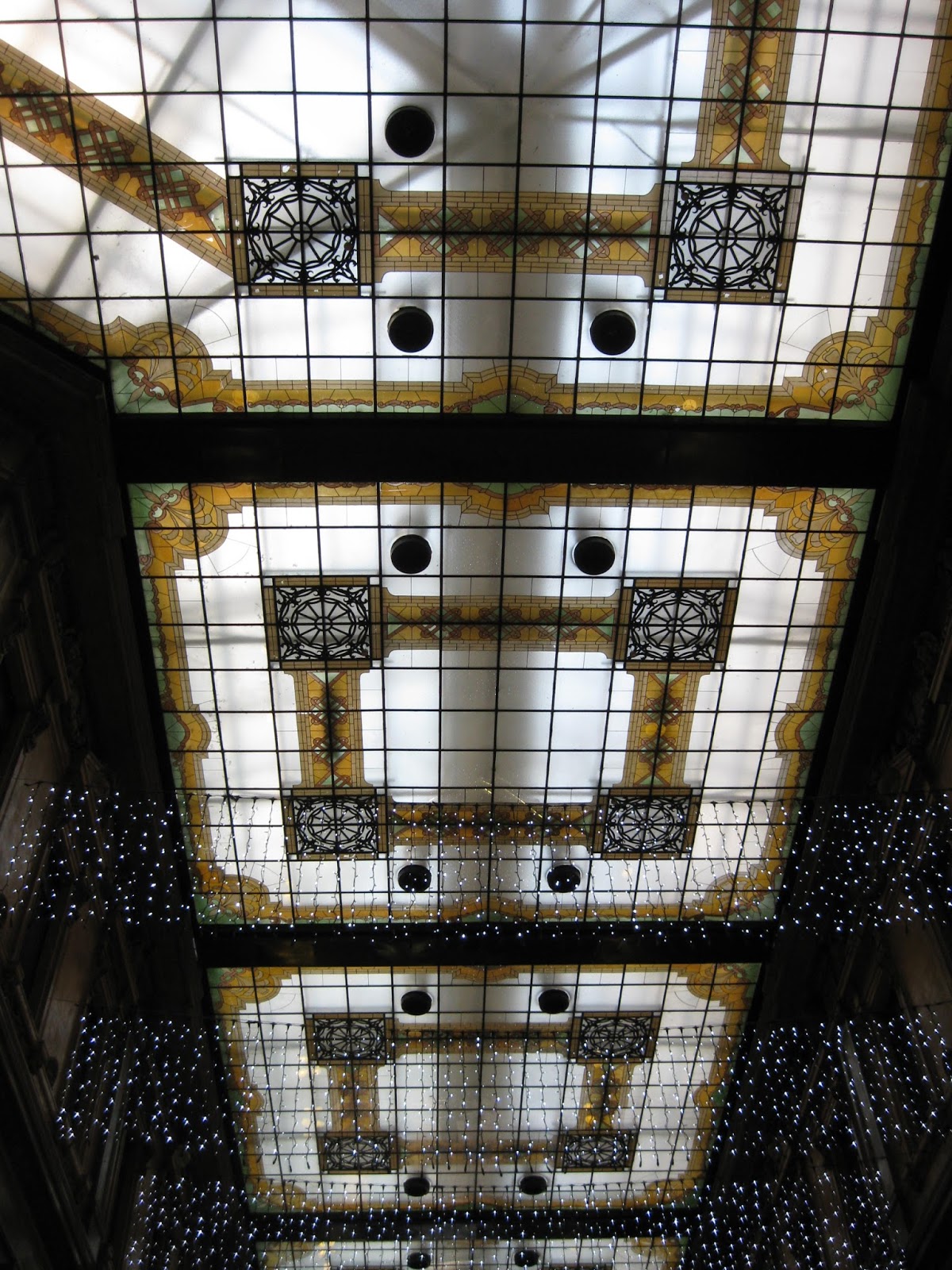
Opposite the Piazza is the restored art nouveau Galleria Colonna. It was renamed Galleria Alberto Sordi after a famous Roman actor who died in 2003 the year the gallery was re-opened in its present incarnation as a shopping mall.

After a brief foray into the gallery, to a large book shop, I continue up the Corso towards Piazza del Popolo. I pass by Palazzo Chigi home of the Prime Minister.

It was bought by the Chigi family, from the Aldobrandini who had run out of money and left it unfinished. The Chigi finished the job. Pope Alexander VII (a Chigi) was  responsible for tidying up Piazza Colonna and much of the Corso which up until then had been semi-permanent building site. 

  Since  the 15th century the Corso had been a  fashionable place for new building projects funded by either the church or the nobility. Churches sprung up mushroom like and nobles erected palaces. Then as now, resources would run out and a once sprightly building site would be reduced to disuse and abandonment.

 As I walk down the road past the entrance to the upmarket Via Condotti with a distant glimpse of the Spanish Steps, past the impressive Fendi building adjacent to a vast H&M retailer, I notice the many signs affixed to facades telling people of illustrious guests, or the names of the palazzi, or old faint letters which describe a past occupation for the building. The history of the road is there for all to read.

The old Metropolitan cinema, where I used to see films in original version, is still there, all boarded up. Numerous shops have come and gone. 

The church of Santa Maria dei Miracoli is hidden under scaffolding but its 'twin' Santa Maria in MonteSanto has come out of wraps looking cleaner. They are both 17th century baroque churches.

I stand at the end of the street and look northwards just making out through the crowd which is growing by the minute, the white Victor Emmanuel monument, 1,5 kilometres away.


Wednesday, 30 November 2016

Of bells and balls

I'm not one to go into a church but in a city with over 900 churches I have strayed. Though I might add, as I belong to no creed, I have never attended mass.

I've visited as tourists do the four papal basilicas: St. Peter's, St Mary Major (Santa Maria Maggiore), St. John the Lateran (San Giovanni in Laterano) and the one closest to my home, St Paul Outside the Walls (San Paolo fuori le mura). They are all temples of opulence and magnificence with many a splendid art work ensconsed within but I dislike them.

My favourite church in Rome must be The Pantheon, for its past as Hadrian's Mausoleum,  rather than its present as yet another Roman catholic place of worship. However, it is its conversion to the latter role that over the centuries has saved it from destruction.

My daily life is monitored by the tolling of the bells of my local parish church, a modern ode to architectural hideousness: Our Lady Of Lourdes ( Nostra Signora di Lourdes). The 7.15 bells act as a wake up call and if I'm still in bed by the time the 8.45 bells ring, it's time to quit dawdling and get up.

My alarm clock in Winter


More mournful are the daily tolls that signal the passing of a life. But this is the high point of the Catholic calendar. The Immaculate Conception will be celebrated on the 8th December followed by the Vigilia (Christmas Eve) on the 24th of December and closing with the Epiphany on the 6th of January.

Traditionally, the 8th of December is when families get together to decorate their homes in the timeless tacky glitz that marks the festive season around the globe. Why, even the Pope has a gigantic fir tree erected in his forecourt, a kind donation from a Scandinavian country. 

Families get out the dusty boxes of carefully - or not - stored away baubles and lights along with the Christmas crib. A nod to the fact that this is a Roman Catholic country. The festivity is all about celebrating the birth of a child long ago in a distant land, isn't it?.

Christmas cribs can be formidable elaborations - forget the pastoral delights of 'Away in a Manger' - and enter another dimension. A road in Naples is dedicated to providing the various pieces and figurines that make up a crib, these include politicians and actors alongside the three wise men and other more traditional figures of the nativity.

Every year on Piazza del Popolo in Rome an exhibition entitled '100 presepi' is dedicated to this art of excess and gaudiness. 

The approach of the festive season this year has made me somewhat perplexed. Ten days into November I observed a Father Christmas puppet dangling out of a neighbour's window. Surely, Father Christmas should be preparing for his multiple commercial centre appearances around the world at this point?

 Festive lights began to adorn balconies a week ago though the local discount supermarket got all dolled up a couple of weeks back. The supermarkets began stocking their mountains of panettone and pandoro around the middle of November. And something called 'Black Friday' made its debut.

Signs went up in shop windows 'Black Friday weekend' and 'Black Friday lasts till Sunday' which made me think that some retailers might not have understood that Friday is just a day. 

No use denying it, even in a traditional country like Italy, consumerism is winning.


Sunday, 27 November 2016

La tenuta: the nature reserve

It's Sunday, house cleaning day and dog walking day, as in, we go for a really long walk. A decision has to be made: where shall we go for our walk? I'm spoilt for choice. 

The area we live in is surrounded by large parks : the Caffarella with its pasturing flock of sheep, the Appia Antica with its Roman ruins, catacombs and tombs, and a nature reserve called the 'Tenuta di Tor Marancia'. This rather grandly translates as the 'Estate' of Tor Marancia, and history suggests that once upon a long ago it may have been formidable.

The area derives its name from that of a freedman, one Amaranthus, who would have worked for the Numisii Proculi family in the 2nd century AD. The Numisii had their country home here which was run as an agricultural business by their slaves.

 Another origin story more prosaically states that the area was named after an edifice of unspecified use, off the Via delle Sette Chiese past the Catacombs of Domitilla.

In the end, and despite the heavy rain of the last few days, I go for the tenuta. I haven't been there in a while and am eager to see how the approaching Winter is changing the vegetation. Besides, it's a nice sunny afternoon, far too warm for the season.


 I walk down my road on which can be found one of the last of a series of medieval towers which were built as look-outs. It is called Tor Marancia but, originally and up until the 16th century, it  was called the Torre di San Tommaso (Tower of St Thomas). It is situated in the Park of Tor Marancia, a sad, fenced-off area near some plain, weather beaten buildings where childrens play things: swings, slides and a climbing frame, are enveloped in a carpet of weeds.

I head towards Piazza Lante. This is where official tours of the tenuta start, right next to the local eyesore: an electric power station. Over the years many attempts have been made to close it down, as more and more cases of cancer in children have appeared. But to no avail.

I climb the hill past the humming station and ignore the entrance to 'needle lane' (my moniker for it), so called because of the plethora of abandoned needles and other addict paraphernalia I came across on one early morning walk a couple of years ago. There also used to be an unofficial gypsy encampment at its far end beside the cactus grove. Over the years gypsies have come and gone, setting up camps in the caves or among the thick bushes of the park.

Up on a ridge there are views to the distant Castelli Romani. It was a prehistoric eruption of those distant Alban Hills that created the park with its distinct ridges, quarry, streams and fertile land.

Inside the tenuta, in an extensively quarried area, there is a 200-metre long and 20-metre high facade which shows the various strata of earth:  tufo (706 - 680,000 years old), red and black pozzolanic ash from 528,000 to 338,000 years ago and others. It is this ash which has been quarried creating numerous caves and galleries within the sediment. 
Quarry face with its various sediment strata
 Today's walk takes me past an enclave of rosemary bushes, some apple and pear trees, large bramble bushes which at the end of the summer yield crops of berries and down towards a larger path.

At its end is the old farm house, the Casale di Tor Carbone and the humid area of the park which is crossed by some water ways and where a few walks back I came across a fresh water crab. 

I cross over this path towards a large field. In the spring it is covered in wild flowers and thistles then it becomes churned up earth and mud, now it is a verdant expanse.

 Pigeons peck at the earth. At its far end are the remains of old constructions just cement bases and rocks and bricks. Climbing up past these I can see in the distance the mausoleum of Caecilia Metella and the Church of San Sebastiano on the Appia Antica.

From here there are two options: the lower path which leads past a ruined farm house or on the upper ridge of the quarry past a crop of bamboo rushes. I opt for the latter.

 I move onto a smaller path covered in grass, the bramble bushes are thick with spider webs and the rushes rustle in the breeze. I'm beyond the area most fellow dog walkers choose to go to and all I can hear are the bird calls mainly parrots and singing blackbirds with the odd raucous yell of a high-perched crow. 

The tenuta is known for its diverse fauna and flora: quail, kestrels, weasels, fox, brown kite, moorhen, red breasts,dragon flies, various amphibians and reptiles are all known to live in the reserve next to elms, ferns, willows, poplars, numerous clusters and bushes of herbs such as sage, rosemary, parsley, spear mint as well as apple and pear trees.

A late Spring bale of dried up grasses and weeds


Whatever the season, the tenuta is worth a visit.


Monday, 7 November 2016

ch...ch...ch...changes

"How much do you think you have been changed by living in Italy." I looked at my interlocutor, it was a deep question I wouldn't have expected from him. I sipped my tea.

"Well, " I paused, and looked across the table at a colleague who was fiddling about with the computer, "maybe I'm more tolerant of certain situations or less impatient. No point getting annoyed if people turn up late for appointments if it's a national trait." I shrugged.

"There's also waiting for ages in a bank, or the post office, just to have an elderly person cut  in front when it's your turn. I'm kinda used to that" piped up my colleague. 

"Or no change at the supermarket. The one at the foot of my building never has 2 cents."

I nodded, "Or we have to take it as read that it's perfectly normal to receive a bill the day before its deadline, if not actually after." We all nodded sagely. We all knew about the last minute rush to the post office to pay a bill that should have been paid yesterday. Even more stressful when the bill in question was a tax bill.

"Or that we usually wait over forty minutes for a bus that is supposed to pass every 15 minutes" said the original interlocutor.

"Or there's accepting that even the most basic discussion will last three times the time it would anywhere else, due to the national tendancy not to get to the point."We had all suffered that one.

We looked at each other. How wise and tolerant we had become.  

A few days after this conversation, I was leafing through a recently purchased cook book by a famous British chef I greatly admire. There were, as ever,  lots of mouth watering pictures of food beside their recipes. I was deciding which I'd attempt first bearing in mind that some ingredients are difficult to get here.

I turned the page. And recoiled. Surely not? I risked a glimpse. The horror... There in front of my eyes was a platter of tomato spaghetti with chunks of chicken atop and aspargus laid in a fetching criss cross pattern. Carbs, protein and veg. What was the problem? Had it been rice or mashed potatoes I wouldn't have blinked.  But spaghetti rosso? No. It was a melding of an Italian primo with a secondo and the contorno heaped on top. "Ca ne se fait pas," as my mother would say to explain just about anything when I was growing up. It just isn't done.

the 'shocking' dish
It brought me back in time to the infamous 'Pizza Hawai': a doughey concoction heaped with chunks of pineapple, pieces of chicken and grated emmental melted on top. On days when my mother didn't feel like cooking we would go to the local mini-market and there sat the monstrosity ensconsced between a goat cheese and ham pizza, and a Margherita that bore little resemblance to the Italian original as this one had parsley in the place of basil and grated emmental (always a favourite in Northern Europe) in lieu of mozarella with large slices of watery beef tomatoes.

 Yet at the time, I ate it with relish, in fact all these pizzas struck me as pretty good. Now I wouldn't touch them with a barge pole. 

Equally alarming was the Norman pizza which I found myself eating one summer. In my defence there was nothing else to eat. 

I had given instructions relayed via a third party over the phone: pizza bianca with tuna. 
The take away person asked : "anything else?"
 "Slices of onion."
 "That's all." 
"Yes," as I walked away I heard my bother-in-law whispering into the phone, "I know. but she lives in Italy."

Half an hour later, the pizzas arrived. Mine was bianca (without tomato sauce) with tuna and onions and  a large dollop of Norman double cream slap bang in the centre festively adorned in basil, parsley and oregano. I regarded it, shook my head and bit the bullet (it tasted fine.) I noted that the other pizzas at table had cream on them. It seems Normans put cream on everything.

This may seem a tad fussy, after all food is food. Tastes vary from place to place and nation to nation. However Italians take their food and associated traditions very seriously. A famous Italian chef, a Masterchef judge, once revealed his secret ingredient for the dish of 'Bucatini all'amatriciana'. It was an unpeeled clove of garlic added to the sauce.

The furore that ensued was epic. The mayor of Amatrice invited the starred chef to Amatrice to try the real deal. There was no mucking around with such a traditional dish, food stars or no food stars . 

For the record, according to tradition, the Amatriciana sauce is made with guanciale (cheek lard), pecorino cheese, white wine, San Marzano tomatoes, pepper and peperoncino (Italian red chili peppers). Sadly, today the mayor of Amatrice has more pressing problems to deal with as a large proportion of his town was shaken to the ground this summer, just days before the annual pasta fair.

So has living in Italy changed me?  As regards my attitude to food, if it's a pasta dish, most certainly. I've never paid much attention to the cappucino rule - never after 11am or lunch as the milk prevents digestion - I don't like cappucino. I tend to ignore bathing rules: just after eating or else you have to wait 2 hours. Again, digestion has something to do with it. Italians have quite a few digestion-related hang ups.

 I rarely scare at the 'colpo d'aria' - literally 'hit by the wind' aka a draught - which seems to worry a lot of people and provoke the risk of catching all kinds of nasty illnesses.

 I thought I'd become more tolerant and less impatient but a recent flare up with, of all people, an Italian boss, may indicate that like the Vesuvius, my impatience tends to be dormant and can still erupt unpredictably. 

Bellissimo cavolo nero. An Autumn prince.